630-462-9500
After Hour New Client Telephone Number 630-690-6077
1776 S. Naperville Road, Building B, Suite 202,
Wheaton, IL 60189

-

- Home
- Firm Overview
- Attorneys
- Practice Areas
- Divorce
- What To Expect During Your Divorce
- How To Choose A Divorce Attorney
- Divorce Planning
- Protecting Your Credit During Divorce
- Settlement Vs. Trial
- Alimony / Maintenance
- Unallocated Alimony
- Taxes and Divorce
- Distribution of Marital Property
- Dissipation of Assets
- Retirement Plans, IRAs And QDROs
- International & Interstate Divorce
- Post Divorce Modifications & Enforcement
- Divorce FAQs
- High Net Worth Divorce
- Child Custody
- Child Support
- Collaborative Law
- Mediation
- Family Law
- Appeals
- Criminal Representation
- Divorce
- Testimonials
- Media
- Blog
- Contact

What Defines Irreconcilable Differences in Illinois Divorces?
 According to the Centers for Disease Control and Prevention, over 670,000 divorces are finalized in the United States each year. Each of those cases requires "grounds," or a legal reason, to get divorced. Some states still allow fault-based divorces like abandonment or cruelty. But Illinois simplified its divorce laws to focus on one central question: Has the marriage broken down beyond repair? If so, irreconcilable differences is the only grounds available.
If you are considering divorce in 2026, understanding exactly what irreconcilable differences means can help you approach the divorce process with realistic expectations. Contact our Wheaton, IL divorce lawyers to get the help you need as you navigate this difficult time in your life.
What Are "Irreconcilable Differences" in an Illinois Divorce?
"Irreconcilable differences" is a legal term that means the marriage relationship has broken down and cannot be repaired. Under 750 ILCS 5/401, Illinois law requires that:
-
Attempts to fix your marriage haven’t worked
-
Continuing to try to fix it isn’t practical, and
-
Continuing to try to fix it wouldn’t be in the best interests of your family
Other than that, the court does not need to know why the marriage failed – only that it has.
This standard is vague on purpose. Irreconcilable differences can include many different issues that couples commonly have. This includes:
-
Communication problems
-
Personality clashes
-
Infidelity
-
Different values or life goals
-
Financial disagreements
-
Simply growing apart over time
There is no specific list of qualifying reasons. As long as both spouses, or at least the spouse filing for divorce, genuinely believe there is no reasonable prospect of saving the marriage, they can get divorced.
Why Did Illinois Get Rid of Fault-Based Divorce?
Illinois became a pure no-fault divorce state in 2016 when the legislature removed all fault-based grounds from the law. Before this change, spouses could file for divorce based on accusations like adultery or abuse. These fault-based cases often turned into long, expensive battles where each side tried to prove the other was to blame.
The shift to no-fault divorce eliminated the need for either party to prove the other did something wrong. This change allows both spouses to focus on the practical aspects of ending their marriage. Couples can instead put their energy into figuring out how to divide their property or make child custody arrangements.
Does My Spouse Have to Agree That the Marriage Is Over?
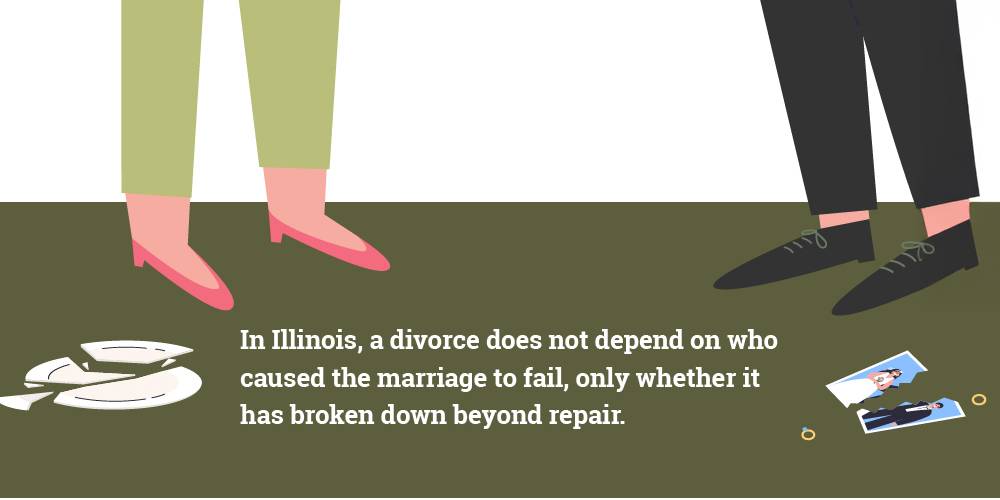
In Illinois, your spouse does not have to agree that the marriage is over for a divorce to move forward. Only one spouse needs to believe that the marriage has broken down beyond repair.
If one spouse claims irreconcilable differences, the court will generally accept that statement. Judges do not force people to stay married or require proof that both spouses want a divorce. This prevents one spouse from blocking the process simply by refusing to cooperate.
That said, a spouse who disagrees with the divorce can still slow things down. They may contest issues like property division, maintenance, or child-related matters. This can lead to more negotiations or court involvement, but it does not stop the divorce itself from happening.
How Long Do You Have to Be Separated Before Filing for Divorce in Illinois?
Illinois does not require a long separation period before filing for divorce. In fact, there is no minimum separation period at all if both spouses agree that the marriage is over due to irreconcilable differences.
If one spouse doesn’t agree that irreconcilable differences exist, the law simply assumes they do once the spouses have lived separate and apart for at least six months. This does not always mean living in separate homes. Spouses can be considered separated even if they live under the same roof, as long as they no longer act like a married couple.
This rule helps move cases forward when one spouse doesn’t want to get divorced. Once the six-month period is met, the court will usually find that irreconcilable differences exist and allow the divorce to proceed.
How Does Cheating Impact Divorce in a No-Fault Divorce State?
Many people wonder whether cheating still matters in Illinois divorces. The short answer is that infidelity cannot be used as grounds for divorce because fault-based grounds no longer exist. However, that does not mean an affair has no impact on the divorce process.
Property Division
Illinois courts divide marital property based on "equitable distribution" principles. While judges cannot punish a spouse for cheating, they can consider how marital funds were spent. If one spouse used money to pay for an affair, the court may make up for that when dividing property. This is known as "dissipation of marital assets."
Alimony
Infidelity can also affect spousal maintenance, or alimony, in some circumstances. Courts consider many factors when setting alimony payments. While adultery itself is not a factor under the law, the financial impact of an affair and its effect on the marriage may be relevant to the overall property settlement.
Child Custody
Child custody decisions in Illinois focus entirely on the best interests of the child. An affair typically does not affect custody unless the cheating spouse's behavior directly harmed the children. For example, having a romantic partner who is a registered sex offender or who uses drugs around children could affect child custody decisions.
How Can You Prepare for a No-Fault Divorce in Illinois?
Even though Illinois divorces do not require proving fault, preparing yourself carefully is still important. You will need to:
-
Organize your financial documents
-
Understand your assets and debts
-
Think about your priorities for property division
-
Propose a custody schedule
Working with an experienced divorce attorney makes sure that someone is looking out for your rights during divorce. A lawyer can help you understand what to expect and negotiate for a fair divorce decree.
Call a DuPage County Divorce Attorney Today
Understanding irreconcilable differences will help you focus on practical solutions for your divorce. To work with a lawyer who is willing to fight for you and your rights, contact the skilled Wheaton divorce lawyers at The Stogsdill Law Firm, P.C.. We have over 100 years of combined experience. Call The Stogsdill Law Firm, P.C. at 630-462-9500 to schedule a private consultation.












Contact Us To Schedule A Consultation With An Attorney At Our Firm
Call 630-462-9500 or provide your contact information below and we will get in touch with you:
The Stogsdill Law Firm, P.C.
1776 S. Naperville Road, Building B, Suite 202Wheaton, IL 60189630-462-9500